Recent recipient of the 1er Prix Luigi Russolo for his work Gallivanting (now retitled as The Suitcases Piece), Donal Sarsfield is an Irish composer currently studying for a PhD in electroacoustic music at the University of Manchester on an Irish Arts Council Elizabeth Maconchy Composition Fellowship. His recent tape music demonstrates poignancy and humour in equal measure, with attention to the detail of even the most ephemeral gesture. For the second of an occasional series of profiles of composers whose music I like (previously: Nina Whiteman), Donal kindly agreed to answer some questions about what makes him tick.
Q&A
Chris Swithinbank: I realise that this is not a question that you probably consider every day, but let’s start at the beginning. What drew you to write music? Is it a vocation and if so, why?
Donal Sarsfield: I always listened to music in my teenage years. I learned to play the piano myself but was always a reluctant practiser; I much preferred improvising to learning pieces. It wasn’t until I went to college and attended composition classes that I got a feeling that I could try things out on paper, and so after a few elemental exercises I wrote my first piece when I was 20. I wouldn’t call composing a vocation.
CS: Having started out writing music for acoustic instruments and voices, you are now working on a PhD in Electroacoustic Composition. What was it about studio composition that you wanted to explore?
DS: After first working in the studio during my MA in 2004 I realised that I enjoyed working with sounds as much as I enjoyed working with notes and instruments. Having been to a respectable number of concerts involving tape or electroacoustic works over the years I felt that most of the pieces I heard, though technically polished, were lacking something personal. By personal I mean either a clearly autobiographical subject matter or the more stubbornly subtle, eccentric or esoteric side to life. That’s the area that I have set out to explore in my PhD; the subject of the personal through sound.
CS: How do you deal with the disembodied nature of tape music?
DS: The photographer Garry Winogrand often said that he photographed something to see what it looked liked photographed and I try and apply the same approach to recording sounds; I record something to hear what it sounds like recorded. Even though 99% of my sounds are derived from recorded sound I never consider the sounds I use as disembodied. I think the term presupposes the “disembodied” element in a lesser light and that seems an unnecessary weight on the work.
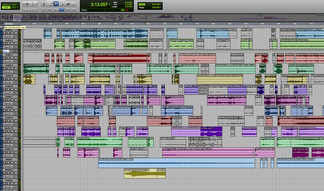
Pro Tools session: The Suitcases Piece
CS: How do you conceive of sound in your work?
DS: I usually have some starting point or concept which I try and realise through sound. This seed evolves through a period of broad preparatory research into areas which I feel might be useful; photography, painting, American 80’s television, and that then informs the practical considerations of constructing the piece: from how and where to record sound sources, how best to transform, organise and combine sounds, and most importantly, how to resolve and structure each sound/gesture within each piece. At the minute I can’t really offer a definition of resolution, it’s more an awareness that within the piece a sound must justify itself and, if removed, would weaken the equilibrium of the work.
CS: Moving from raw recorded sound to a finished piece can be a convoluted process. How do you go about it and what role does the source sound itself play in a piece’s concept?
DS: I always aim to make something not “factually impeccable but seamlessly persuasive”, which is a phrase from John Szarkowski, the man who’s writing I turn to most often when I’m stuck. The first three pieces of my [PhD] portfolio point to an ordinary sound in an imaginative, and hopefully somewhat intelligent, manner. I try and use the sound source as the subject of the piece, rather than just using the sound object as a means to create. Matisse said that “The object is not so interesting in itself. It’s the environment that creates the object.”
CS: In The Clapping Piece (2010) the main material is the sound of applause. There is a wonderful moment just after it ends where the audience anticipates its own applause, recognises that this will be in some way a continuation of the work itself and realises something of the ridiculousness of the concert ritual. Was that a conscious aim? Is a questioning of the concert situation an important part of your compositional approach?
DS: With The Clapping Piece there was an attempt to make an audience not applaud after the piece, but I failed in that respect. I think of that piece as a rather unassuming performance piece for concert hall. More than most pieces it rewards projection within the concert hall environment more than anywhere else (for example a radio broadcast, listening at home, or online streaming).
CS: What projects have you got in the pipeline at the moment?
DS: Thankfully the PhD will be my main project for the next 18 months and I am grateful for this time to make the work as strong as it can be. Outside the PhD I have been participating in the Jerwood Opera Writing Foundation at Aldeburgh and that course culminates in a short new piece with writer Alan McKendrick and director Ted Huffman in July.
CS: What excites you about being an artist today?
DS: Waiting to see what Martin Margiela will do next.
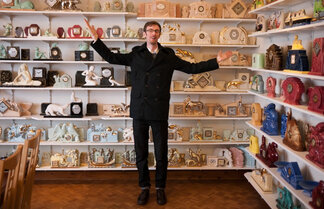
Donal Sarsfield at the Clockarium, Brussels (Photo by Sam Salem)